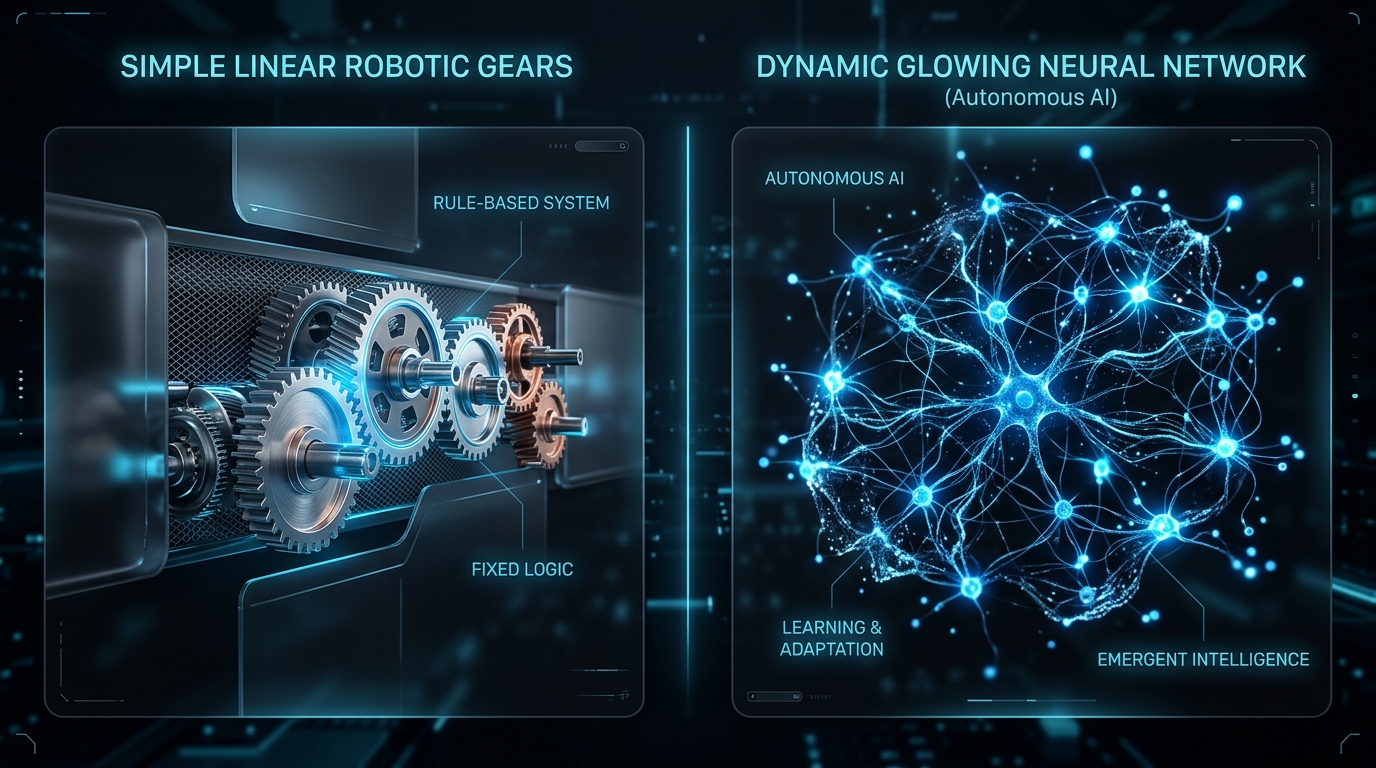
Beyond Zapier: The Difference Between Rule-Based Automation and Agentic Workflows
Understand why companies stall when scaling basic integrations and how autonomous flows (Agentic AI) bring reasoning to B2B automation.
Over the past ten years, almost all digital companies have used tools like Zapier, Make (Integromat), and n8n to optimize processes. The logic was brilliant and straightforward: "If A happens in system X, then do B in system Y".
These Rule-Based Automations solved trivial problems, like sending data from a form to Google Sheets. However, when mature companies try to use this rigid logic to run complex critical operations, the system breaks under its own weight.
The Glass Ceiling of "If-This-Then-That"
Scaling Bottlenecks?
Discover how our AI architecture can automate critical processes in your operation in under 4 weeks.
The problem with traditional automations is that they are blind. If the format of the input data changes by one millimeter (e.g., the customer types their phone number with a country code but without an area code), the automation stops, generating a domino effect of errors (The famous 400 Error - Bad Request).
These platforms have no reasoning. To cover all possible variables in a complex screening pipeline, it would be necessary to create thousands of paths and insurmountable conditionals, requiring a developer just to keep the flow running.
The Solution: Agentic Workflows
In 2026, Infinity Solutions abandoned static logics and began building native Agentic Workflows. The main difference is the introduction of cognitive reasoning in the middle of the integration.
Instead of passing blind data from A to B, we inject an LLM (Agent) into the middle of the pipeline:
- Data Resilience: The Agent evaluates the input data. If the date is in a European format, it corrects it to the American database format before sending, without the need for a strict Regex rule.
- Decision Making (Routing): If the customer attaches an image instead of a PDF in the support ticket, Zapier would crash. The Agentic flow takes the image, runs it through a Computer Vision model, extracts the problem, and routes it to the correct department.
- Self-Healing: If the destination API goes down momentarily, the flow doesn't give up; it creates a waiting strategy and tries alternative routes.
If your company still spends thousands of dollars on Zapier licensing to cover operational holes, you are bailing out a sinking ship. The automation of the future reasons, judges, and corrects itself.
AI Maturity Diagnostic
Infinity Assessment
How does your company handle repetitive tasks today?
Frequently Asked Questions (FAQ)
Are tools like Zapier and Make obsolete? Not for static tasks of simple data transfer. But for tasks that require interpretation, categorization, linguistic review, or manipulation of complex variables, Agentic Workflows are immensely superior.
What is an Agentic Workflow? It is an automation where connections are not made by rigid triggers, but orchestrated by an AI Language Model. The agent decides the best route and uses tools (APIs) on-demand to achieve a generic objective provided by the human.